


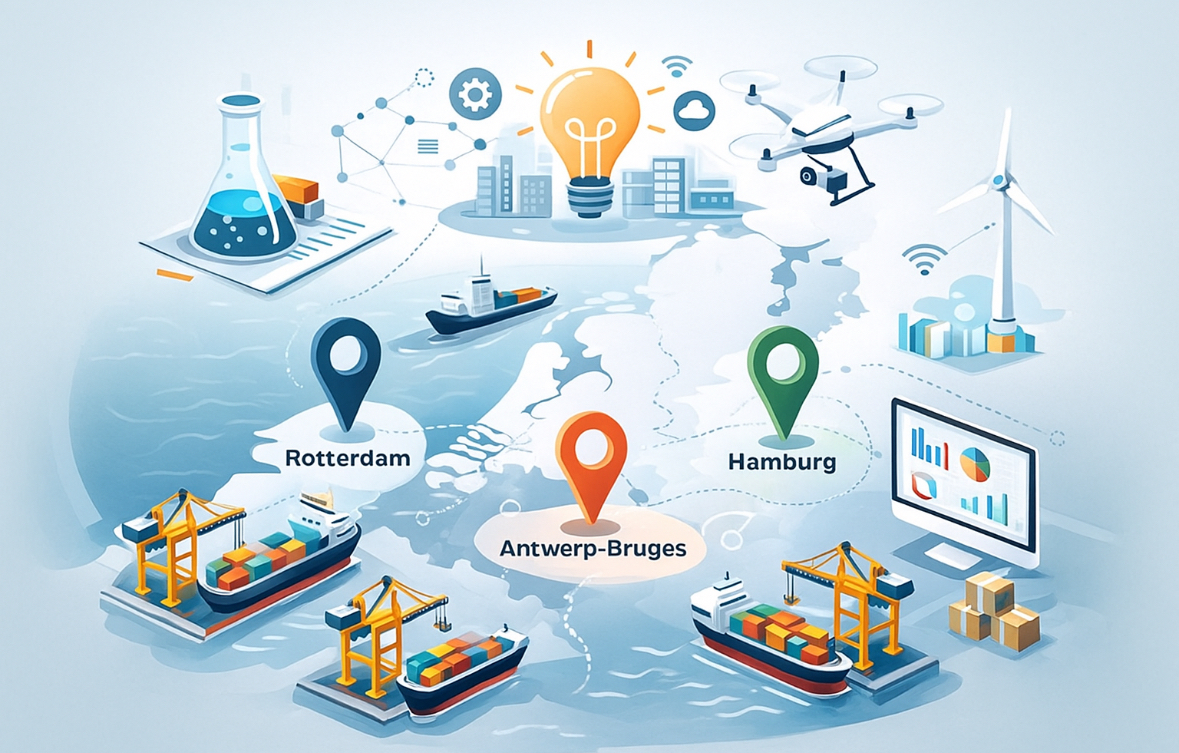
Innovation in ports is no longer a peripheral activity—it is the core strategic engine shaping the competitiveness of global trade. Among the world’s leading maritime hubs, Rotterdam, Antwerp-Bruges, and Hamburg stand out as Europe’s “Golden Triangle of Port Innovation.”
These three ports have developed powerful and distinct innovation ecosystems that combine infrastructure, public-private collaboration, startups, research institutes, testbeds, digital platforms, and transition policies. While each port evolves within its own cultural, regulatory, and economic environment, they share a common vision: to reinvent how ports operate in a data-driven, sustainable, and highly automated future.
This article synthesizes insights from PierNext (Port of Barcelona’s innovation knowledge hub) and from official innovation materials of the Port of Rotterdam, Port of Antwerp-Bruges, and Hamburg Port Authority (HPA), to answer one question: How does innovation actually happen in Europe’s three most influential ports?
1. The Concept of Port Innovation Ecosystems
In the last decade, leading ports stopped thinking of innovation as a department and began treating it as an ecosystem—a network of actors that includes:
- Port authorities
- Terminal operators
- Technology companies
- Startups
- Universities and research centers
- Municipal governments
- Innovation districts
- Venture studios and corporate accelerators
- Logistics and industrial clusters
According to PierNext, this shift aligns ports with global innovation districts such as Barcelona Tech City, Rotterdam Makers District, or Antwerp’s The Beacon. In port cities, innovation doesn’t happen inside the port fence—it happens in the urban-port interface, where logistics, industry, digital technologies, and entrepreneurship intersect.
2. Rotterdam: Europe’s Innovation Powerhouse
Rotterdam is widely recognized as the most structured and advanced port innovation ecosystem in Europe. The city brands itself as “Rotterdam Maritime Capital of Europe”, highlighting a holistic network that integrates shipping, logistics, energy, shipbuilding, and tech.
a. A multi-layered innovation ecosystem
The Port of Rotterdam Authority, together with the City of Rotterdam, fosters an ecosystem built around:
- RDM Rotterdam (Rotterdam Makers District) – former shipyard transformed into a high-tech innovation campus.
- Venture Café Rotterdam & CIC Rotterdam – spaces where corporates and startups interact.
- Erasmus University + TU Delft + Rotterdam University of Applied Sciences – academic backbone of research and talent creation.
- Accelerators and venture studios – PortXL being the most recognized global port accelerator.
Rotterdam’s ecosystem is characterized by density, institutional coordination, and a strong link between universities and industry.
b. Open testbeds: innovation by experimenting
Rotterdam leads Europe in the creation of living labs, places where new solutions can be tested in real environmental and operational conditions:
- AquaDock (floating solutions testbed)
- Digital Twin Port Lab
- Automation test areas for autonomous inland vessels, drones, and AGVs
- Hydrogen testbeds, including H2GS and large-scale electrolysis pilots
These testbeds are not only technological spaces—they are regulatory sandboxes where new operational, safety, and compliance models are co-designed with authorities.
c. Digitalisation and data infrastructure
Rotterdam treats digitalisation as a strategic infrastructure—like a quay wall or a breakwater.
Key initiatives include:
- PortBase, the Netherlands-wide port community system.
- Digital Twin of the Port of Rotterdam, integrating real-time data from vessels, cargo flows, meteorology, and infrastructure.
- AI-based prediction models for ETAs, congestion, berth availability, and nautical planning.
- The “Connected Port” strategy to integrate stakeholders through standardized data-sharing.
d. Energy transition and climate innovation
Rotterdam is Europe’s largest energy port—therefore the port positioned itself as a European hub for decarbonization:
- Hydrogen import corridors with Portugal, Chile, and Middle Eastern countries
- CO₂ transport and storage (Porthos project)
- Shore power expansion plans
- Biofuel and e-methanol clusters
- Large-scale offshore wind integration
The combination of digital leadership, energy transition, and living labs makes Rotterdam not only Europe’s innovation leader but a global benchmark.
3. Antwerp-Bruges: The Smart Port of Europe
The Port of Antwerp-Bruges has a long-standing culture of operational excellence, chemical cluster leadership, and strong collaboration with the city. In recent years, Antwerp-Bruges has positioned itself as the “Smart Port” of Europe, focusing on technologies that improve safety, mobility, automation, and multimodal integration.
a. The Beacon: Antwerp’s innovation lighthouse
At the center of Antwerp’s innovation ecosystem stands The Beacon, created to link:
- Smart ports and logistics
- Smart cities
- Smart industry
The Beacon is a collaborative hub formed by:
- City of Antwerp
- University of Antwerp
- IMEC (Europe’s leading microelectronics and digital research institute)
- Port of Antwerp-Bruges
- Private companies and startups
This unique mix makes Antwerp one of the few global ports with a deep technology research institute (IMEC) actively embedded into port innovation.
b. Innovation districts and corporate partnerships
Antwerp leverages its strong chemical, petrochemical, and manufacturing industries. This means:
- Multinationals (BASF, ExxonMobil, Borealis, Covestro) participate directly in port innovation
- Robotics and IoT solutions are co-developed with industry
- Cybersecurity is a major innovation vertical due to critical infrastructure concentration
c. Digital innovation in port operations
The Port of Antwerp-Bruges invests heavily in AI, sensors, digital twins, and situational awareness systems:
- NAUTIC (Nautical Operational Tool for Information & Coordination)
- Unifiling and digital customs solutions
- Digital Twin of the port, using real-time operational data
- Smart cameras and drones to monitor assets, traffic, pollution, and safety
The port is one of Europe’s earliest adopters of drone fleets for inspections and emergency response.
d. Multimodality and mobility innovation
Antwerp-Bruges is Europe’s leading inland waterways hub, deeply integrated with the Belgian waterway authorities.
Its innovation priorities include:
- Automation of barge movements
- Digital barge traffic management
- Synchromodal logistics and urban logistics pilots
- Hydrogen-powered barges and green corridor initiatives
e. Energy transition
Antwerp-Bruges is developing a major hydrogen import cluster, a CO₂ backbone, and circular economy initiatives connecting the large chemical cluster to renewable feedstocks.
Together, these elements create a flexible, urban-innovative, research-driven ecosystem centered on digitalisation and smart technologies.
4. Hamburg: Europe’s Living Lab for Urban-Port Innovation
Hamburg is not only Europe’s third-largest port—it is one of the continent’s most innovative port cities, driven by the interplay of:
- The Hamburg Port Authority (HPA)
- The city’s strong digital economy
- Major corporations (HHLA, Airbus, Lufthansa Technik, Aurubis)
- A large startup scene
- Advanced governance of multimodal mobility
Hamburg is unique because innovation happens not only in the port but across a city-wide innovation ecosystem.
a. homePORT: Hamburg’s open-air testbed
Perhaps the most iconic symbol of Hamburg’s innovation strategy is homePORT, the port’s official test and co-creation space, operated by HPA.
HomePORT is:
- A physical space for testing drones, robots, autonomous vehicles, and maritime technologies
- A community hub for startups, universities, and corporates
- A founder of the Port Innovators Network (PIN), connecting innovation hubs worldwide (Rotterdam, Antwerp, Valencia, Singapore, etc.)
HomePORT embodies the “sandbox culture” of Hamburg: experiment first, regulate later.
b. Drone innovation leadership
Hamburg is one of Europe’s most advanced cities in the use of drones for industrial and port applications:
- DronePort Hamburg works with Airbus, HPA, HHLA Sky, and other partners
- Drones are used for:
- Bridge inspections
- Berth monitoring
- Emergency response
- Maritime safety
- SmartBRIDGE Hamburg (digital twin of Köhlbrandbrücke)
Hamburg is co-leading cross-border drone regulation and collaborating with Rotterdam and Antwerp in the DroneHorizon initiative.
c. Digital transformation and smart infrastructure
HPA’s innovation agenda focuses on:
- smartPORT logistics – integrates traffic management, truck flows, and mobility data
- smartPORT energy – energy efficiency and renewable integration
- Digital twin of the port – monitoring assets and infrastructure
- Automated terminals, especially HHLA’s Container Terminal Altenwerder
- Port traffic tower digitalization, managing one of Europe’s densest maritime approaches
d. Energy transition
Hamburg’s energy innovation is grounded in:
- Hydrogen import and distribution
- Offshore wind assembly and maintenance operations
- Electrification of terminals and port equipment
- Collaboration with northern Germany’s energy clusters
e. Startups and urban tech
Hamburg has one of Germany’s largest startup communities, especially in:
- Mobility
- Logistics
- Drones
- Media and digital technologies
The city’s innovation climate spills directly into the port, creating a true city-port innovation continuum.
5. Comparing the three port innovation ecosystems
Rotterdam → The Industrial-Scale Innovator
- Largest and most structured innovation ecosystem
- Strong academic partnerships (TU Delft, Erasmus)
- Large-scale testbeds
- Deep focus on energy transition (H2, CO₂, offshore wind)
- Leading digital twin and data-sharing infrastructure
- Innovation as a continental strategy
Antwerp-Bruges → The Smart & Digital Port
- Strongest research base via IMEC
- Best integration between smart city and smart port
- Leader in digital situational awareness and multimodal innovation
- Innovation driven by chemical/industrial cluster
- The Beacon as a unique applied technology hub
Hamburg → The Urban-Port Sandbox
- Most experimental living labs (homePORT, drones, robotics)
- Best integration between startup scene and port authority
- Highly advanced use of drones and digital urban infrastructure
- Strong mobility innovation, smart traffic management, multimodal urban logistics
- Innovation culture aligned with the city’s creative and digital economy
Each port has created its own model—industrial (Rotterdam), digital (Antwerp), and experimental (Hamburg)—but they increasingly collaborate to develop cross-border standards, especially in drones, hydrogen, digital twins, and data.
6. What the three ports teach us about innovation
Across all three ecosystems, three principles emerge.
1. Innovation requires a governance model, not isolated projects
All three ports treat innovation as a strategic coordination role:
- Dedicated innovation teams
- Public-private partnerships
- Long-term transition plans
2. Physical testbeds accelerate adoption
Living labs like RDM, The Beacon, and homePORT create environments for real-world testing—critical in heavily regulated sectors.
3. Digitalisation is the backbone of modern port competitiveness
AI, sensors, digital twins, and data platforms are not “nice to have”—they shape:
- Vessel arrival efficiency
- Terminal performance
- Nautical safety
- Emissions reduction
- Supply chain visibility
4. Innovation increasingly focuses on climate and energy transition
Hydrogen, CO₂ logistics, electrification, and renewable energy clusters dominate the long-term innovation agendas.
5. Collaboration beats competition
Rather than competing alone, Rotterdam, Antwerp-Bruges, and Hamburg increasingly co-develop standards and pilot technologies.
7. Conclusion: Three Ports, One Future
Innovation in European ports is not random—it is systemic. Rotterdam shows how innovation at scale transforms industrial regions. Antwerp-Bruges demonstrates how digitalisation and smart technologies can make a port safer, more efficient, and more connected. Hamburg proves the power of experimentation and urban innovation ecosystems. Together, these three ports are shaping the future of maritime logistics, turning Europe into the global reference for smart, sustainable, data-driven port operations. As technology accelerates and climate transition reshapes the maritime sector, these ecosystems will not only define the competitiveness of their own regions—they will set the global standards for how port innovation happens.
